
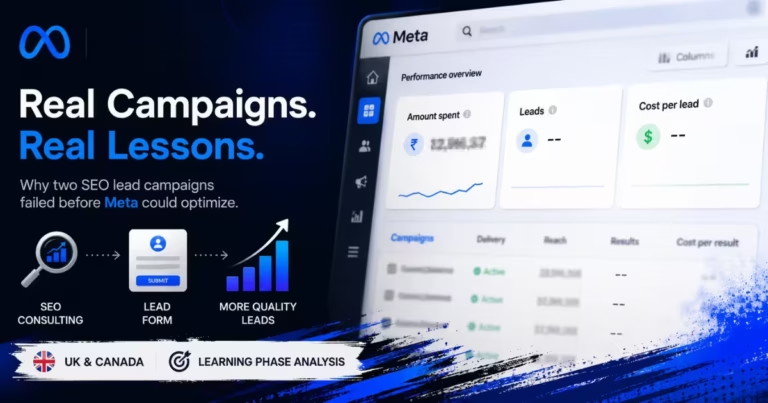
This case study reviews a Meta Ads program for a B2B digital consulting brand. The brand targeted the United Kingdom, the United States, and Canada. These three countries are some of the most competitive and expensive digital ad markets in the world. Brand awareness and engagement campaigns launched in April 2026 and ran successfully for months. Two separate lead generation campaigns launched during that period but stopped within days. Neither lead campaign produced a confirmed lead before it ended. This gap between steady awareness results and quick lead campaign stops holds the real lesson. Meta’s algorithm needs time and volume to find the right buyers in expensive markets. This case study breaks down what happened, why it happened, and what to do differently next time.
Campaign Background
The brand sells SEO consulting services to business clients across North America and the UK. Awareness and engagement campaigns began on April 30, 2026, across the UK, the US, and Canada. By the time of writing, those campaigns had run for roughly seven weeks straight. Two of those campaigns remained active, while several others had completed their planned run. The campaigns covered more than a dozen cities, from London and Toronto to smaller regional markets. This breadth reflects a deliberate attempt to build visibility across three highly competitive countries. The choice of markets was not casual. The US, the UK, and Canada sit among the world’s biggest ad markets by overall ad spend. That scale brings opportunity, but it also brings intense competition for attention and clicks. Inside this larger program, two lead generation campaigns tried to convert that visibility into leads. One campaign targeted Calgary, Canada. The other targeted a regional market in the UK. Both ran for a short window, well under the seven days Meta typically needs to learn.
Strategy
The original strategy followed a logical funnel: build awareness, then engagement, then leads. Awareness campaigns aimed to put the brand in front of new audiences across each market. Engagement campaigns aimed to turn that visibility into likes, visits, and early signals of interest. These signals matter because most of that audience interacts with ads on a phone. Statista reports that 98.5% access Facebook via mobile phones worldwide. That number explains why creative needed to work as well on a small screen as a desktop. Once awareness and engagement built familiarity, the plan called for slow, tested lead generation. That third phase needed time to test audiences, creatives, and offers before scaling spend. The lead campaigns, however, did not get that runway.
Challenges
Two challenges defined this stage of the program: testing time and budget size. The first challenge was testing time. Both lead campaigns were paused before sufficient learning data was collected. Meta generally needs 50 optimization events per week to exit its learning phase. Without that volume, the algorithm cannot tell which audiences and creatives actually convert. The testing phase concluded before statistically meaningful data could be gathered in either case. The second challenge was budget size relative to market cost. The UK, the US, and Canada are not cheap places to test paid social ads. As WordStream notes, a low budget slows learning on Meta. Budget and timeline constraints reduced the scope for audience and creative testing in both attempts. The available testing period was insufficient for full funnel optimization across either market. Additional time and iterative testing would likely have produced more reliable performance insights.
Results
Awareness and engagement campaigns delivered steady, measurable results across every targeted city. Reach climbed into the tens of thousands in several markets over the campaign period. Engagement, including profile visits and likes, grew steadily across nearly every audience segment. These results matched what awareness and engagement campaigns are designed to do. Lead generation told a different story.


Neither the Calgary campaign nor the UK regional campaign generated a confirmed lead. Both produced impressions and reach, proof the ads were delivering, but no conversions followed. This outcome lines up with industry benchmarks for the channel. The average cost per lead on Facebook climbed 21% year over year to about $27.66 in 2025. Costs like that add up fast against a short test window in a large, competitive market. A short campaign rarely generates enough volume to absorb that kind of cost per lead.
Analysis
Three forces combined to limit how far these lead campaigns could go. Time was the first force. Algorithms need data, and data needs days, not hours. Budget was the second force. Expensive markets need enough spend to gather that data quickly. Scope was the third force. Multiple cities at once spread a limited budget even thinner. None of these forces points to a flaw in the brand or in the underlying strategy. They point to a mismatch between test duration, market cost, and the data Meta needs to optimize. Awareness and engagement campaigns avoided this mismatch because they were not optimizing toward a hard conversion. Lead generation campaigns cannot avoid it, since leads are exactly the harder, rarer event. This is a structural challenge tied to timing and budget, not a creative or targeting failure.
Lessons Learned
- Meta Ads need real time to produce meaningful, repeatable results, not just early signals.
- Lead generation campaigns should never be judged after only one or two days of data.
- Competitive countries like the US, the UK, and Canada require realistic, well planned budgets.
- Small budgets spread across several expensive markets usually produce weak, inconclusive lead results.
- Campaigns need enough runway to test audiences, creatives, and offers before anyone judges them.
- Early campaign stops prevent the algorithm from gathering the data it needs to optimize.
- Strong Meta Ads results usually come from iteration, not from a single quick attempt.
- Long term collaboration and shared expectations between client and agency support better outcomes overall.
Recommendations for Future Campaigns

A few practical changes would improve the odds for future lead generation campaigns. Pick one or two priority markets rather than testing three expensive countries at once. Set the testing budget high enough to reach roughly 50 optimization events within a week per ad set. Commit to a minimum test window, ideally seven to fourteen days, before reviewing results. Build a clear measurement plan before launch, since ROI measurement is marketers’ top 2026 challenge. Agree in advance on how long a test will run before anyone evaluates performance. Separate awareness budgets from lead generation budgets, since the two serve very different jobs. Review results together as client and agency, using agreed metrics rather than gut reaction.
Final Takeaways
Budget size and lead generation success are closely linked in the data available today. Only 37% of businesses spending under $1,000 a month called paid ads a top lead source. That figure jumped to 71% among businesses spending $10,000 or more a month, according to recent small business survey data. This case lines up with that pattern. Limited budgets, spread thin, rarely convert to leads quickly. None of this means lead generation is impossible in competitive markets like the UK, the US, or Canada. It means lead generation needs a budget and timeline that match the size of the market. With the right runway, the same brand, the same markets, and a clearer test plan could succeed. The biggest lesson from this case study is patience paired with planning, not bigger creative